Showing posts with label brown snake. Show all posts

Saturday, December 31, 2022

The Rest of 2022, Part II: Mammals, Amphibians, and Reptiles

Let's keep going with 2022 sights on our property, continuing from my previous post about breeding birds! Here, I'll share some assorted highlights featuring mammals, amphibians, and reptiles. We'll still need some more posts after this. Here we go!


Mammals

On June 11 in the woods, I came across a female and male White-tailed Deer who, strangely, didn't run away when they saw me, but instead watched me carefully from not too far away for a few minutes. The female, in particular, was intent on watching me:


The male was a little further back, and I was very impressed with the sizeable antlers he was growing:


I wondered whether there might have been a fawn hidden somewhere nearby, but I didn't see anything, and I stuck to the path so I wouldn't accidentally disturb anyone. The deer and I watched each other for a while, and then I moved on.

Eastern Chipmunks are a common feature in our yard throughout the non-freezing months, and I couldn't resist a picture of this chipmunk on our old hollow apple tree on June 20:


Our vegetable garden is generally well-protected with tall netting to keep out deer and short metal fencing with small holes to keep out rabbits and rodents who would love to nibble on veggies. Every once in a while, though, some industrious creature finds a way through these defences, and in July this year, I returned from a trip to find whole bean plants and eggplant branches snipped off by a mysterious muncher, and only some of the leaves on those branches eaten. After a few days (and some more damage), I figured out that the culprit was a mother Meadow Vole who had found enough of a gap in my fencing and had moved her family of babies into a rock pile in the corner of my garden. On July 17, I removed the rocks and uncovered a handful of furry toddlers -- here's one of these cute and hungry creatures:

Meadow Voles are numerous in our yard and meadow, but I don't often get to see them up close like this. I moved the babies outside of the garden, saw the mother make her exit, and re-secured the gap in the fencing where she was probably getting through. Unfortunately, either I didn't successfully fix the gap or the mother vole was able to climb over the ~2-foot fence -- and I read some sources that suggest that voles can indeed climb if they have enough motivation -- because she kept removing bits of the beans and eggplants over the next few days. And then when I put out a live trap in the bean row, hoping to relocate her, she got caught in the trap and died; I suspect now that the trap might have gotten too hot in the sun. I was really sad to have caused the death of this inventive and persistent creature, but it is also true that we have tons of voles here (including her new batch of babies), vole mortality is high in general, and the purpose of my little vegetable garden is to make food for people, not voles. Here's hoping the fence keeps little furry creatures out of the garden in the future; it's really better for everyone if they stay outside.


Reptiles and Amphibians

Our first amphibian sightings this year were on March 19, when night-time temperatures were in the 50s and the ground was damp, and our first really big salamander night was on the rainy night of March 24, when we helped at least 20 Spotted Salamanders across the road near our house in a span of around 10 minutes. Amphibians were waking up and on the move! On March 26, I re-learned that it's best not to tidy up flower beds too early in the year, when I accidentally uncovered a Spring Peeper that was hunkered down in the dirt beneath some dead leaves on this freezing cold day; after taking this picture, I quickly covered the little frog back up:

The night of March 31 was another great time for amphibian movement. Here's a big Spotted Salamander who we helped across the road that night:


And here's a much more awake Spring Peeper on the damp pavement that night:


Although my garden fencing is (usually) pretty good at keeping out unwanted mammals, somehow amphibians and reptiles still find their way inside fairly regularly. I'm not sure how this large American Toad ended up submerged in the garden dirt on May 13, but I was very happy to have it there, and I encouraged it to please enjoy the slug buffet on offer:


This Brown Snake was living in the same rock pile in my garden as the Meadow Vole family, which I uncovered on July 17; I was surprised at this neighboring arrangement at first, but Brown Snakes are too small to pose a threat to voles, and instead this creature is also primarily a slug eater (yes, please, have all the slugs you want):


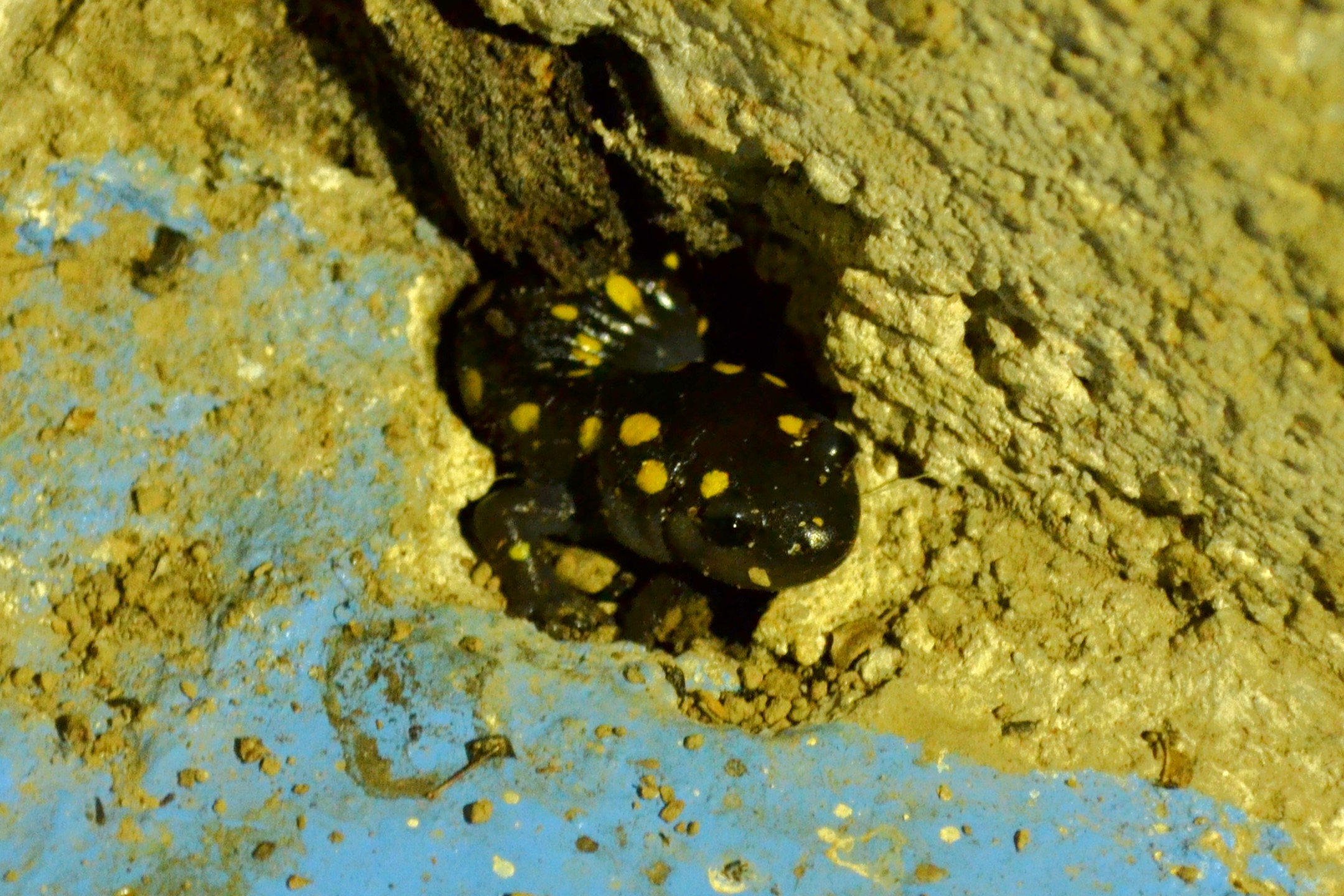
Sometimes amphibians show up in other unexpected places as well. This small Spotted Salamander spent some time in October in a little cave-like corner of our basement, and this is actually the second year we've found a salamander in that same spot; we weren't able to reach the creature well enough to relocate it, so we just enjoyed looking at its friendly face, pictured here on October 24:
I hope this little salamander was able to find its way back out the way it came, because I'm not sure we have enough food for it down here; and in any case, it should probably be sleeping. Good luck, little creature!


In the next post, look for more bird sightings from 2022, followed by insects and flowers!

Wednesday, June 30, 2021

May and June, 2021

In the last post, I shared some highlights from our property in March and April of this year, and now it's time to catch up with May and June!

I couldn't have asked for a better start to May than this close-up view of a male Chestnut-sided Warbler (I love these birds!) who was foraging and singing in the back corner of our meadow on May 2:

Swelling apple blossoms made a pretty stage for this Song Sparrow on May 10:


Eastern Phoebes started this season the same way as last year, with a successful nest in the rafters of an old, barely-weather-proof shed on our property. The phoebes' first egg appeared on April 30, and the five babies fledged by June 7. (I don't have any pictures of that brood to share, because the light in that shed is so poor.) Hooray for more phoebes in the world! Meanwhile, an American Robin built her nest just outside the same shed, on top of a broken picnic table we had leaned up against the shed wall. Here's the robin on her neat mud-rimmed nest on May 13:


Robin babies aren't exactly pretty! Here are the little monsters on May 20:


By May 26, the young robins were covered with mottled feathers and looking just about ready to leave the nest. How nice of a parent to pose here for a family portrait:


I was careful to give these robins plenty of space, but as I walked into the meadow to avoid the very alert robins, I nearly stepped on a Song Sparrow's nest on the ground! I never would have seen the hidden nest if the adult sparrow hadn't rocketed up suddenly when I got close. I took a quick picture of the lovely speckled eggs (as best as I could get without touching the surrounding plants), and then I moved on.... I have no idea how this nest fared after our close encounter. And then a week or two later, I accidentally startled another Song Sparrow from her nest in the opposite end of the meadow. I've learned that I need to avoid straying from the paths in the meadow as much as possible during nesting season! In any case, here's a glimpse of the first Song Sparrow nest from May 26:

This Gray Catbird was putting on quite a concert on the edge of our meadow on May 13 -- I absolutely love this bird's pose with his fluffed-out butt:


 Here's the same bird looking somewhat sleeker from a different angle:


The same as last year, we have a family of House Wrens and a family of Tree Swallows in our two nest boxes (although the birds swapped boxes compared to last year). Here's the male House Wren on May 13, bringing a spider egg sac into the box that he'd already stuffed full of twigs and egg sacs (that's a stick overflowing out of the entrance hole):


The House Wrens' nest must have been somewhere deep inside all those twigs, because I heard noisy babies eventually, but I was never able to actually see the eggs or chicks. I'm pretty sure the brood has fledged by now, but the adults are still visiting the box (perhaps gearing up for brood #2?).

The Tree Swallows and House Wrens seem to have been fairly amicable next-door neighbors, although the Tree Swallows were a little pushy sometimes (which is probably a good thing, keeping the House Wrens in their place). Here's the male Tree Swallow keeping watch from the top of the House Wrens' box on May 21:

At the same time, the female Tree Swallow gathered bits of grass for their nest; it was strange to see a swallow perched on the ground, but very cool to get to see this lady at work:

The finished Tree Swallow nest was perfectly padded with a variety of feathers. Here are the eggs in their nest on June 13:


And the very next day, the eggs had turned into a batch of tiny, brand new swallows:


I saw the nestlings peering out of the nest box hole today, which means the whole swallow family will probably leave us soon. The female Tree Swallow has gotten especially defensive in the past few days, and she's been dive-bombing me when she sees me in the garden or meadow. I will very much miss having the Tree Swallows as a constant feature in the yard, but I suppose it will be nice to not have a bird occasionally swooping angrily past my head.

Indigo Buntings are likely nesting somewhere around here, because I hear a male singing fairly frequently. Here's a male Indigo Bunting (here to stay, or passing through?) surrounded by apple blossoms on May 18:


On May 20, I was surprised and thrilled to see a female Hooded Warbler adding large dried leaves onto a nest right near the path in our woods:

Here's the leaf-covered nest, set in a low Multiflora Rose bush -- I never did see eggs or other activity in this nest, so I suppose this placement didn't work out, but it was still very cool to see this delicate nest-building process, and to have proof that Hooded Warblers breed in our woods:


Our woods were practically dripping with Veeries this spring! I hear and see these lovely thrushes in our woods every year, but they have seemed to be especially numerous this year, with multiple birds singing and calling nearly constantly. Fantastically, the fallen log that our trail camera was watching happened to be something of a Veery stage in late May: the camera captured multiple videos of a male Veery perched on the log and singing, and two nearly identical videos (on different days) of Veeries mating! Here's a compiled video with (1) a Veery singing, (2) Veeries mating, (3) a very wobbly baby White-tailed Deer and its mom (oops, sorry about the typo in the video), and (4) an Ovenbird (often heard in our woods but rarely seen) walking along the log:

May was a wonderful time for flowers (of course), and here are a few highlights from May 20 and 21. Here's Red Baneberry (Actaea rubra), a new plant for me, whose flowers appeared along our woods path (the later red berries on this plant helped me confirm this ID and distinguish it from White Baneberry, which also grows in our woods):

Here's a nice pair of Jack-in-the-Pulpit flowers:


And a perfect Starflower bloom, lit up by some sunlight:


And I was so happy to see this thriving patch of Foamflower in our front yard:

On June 4, a somewhat tattered but still beautiful female Promethea Moth appeared on our deck:


On the morning of June 8, the Spicebush Swallowtail chrysalis that I kept over the winter in our unheated mudroom turned into a butterfly! I had neglected to give the creature a suitable perch in its enclosure (I know better now), so I provided myself as a perch and kept watch over this new and very damp butterfly while it worked on expanding its wings:

After about 20 minutes, it was looking pristine and perfect. Soon after this next picture was taken, I transferred the butterfly to a sheltered leaf to finish drying off, and it stayed there for a while and then presumably left when it was ready:


Also on June 8, the largest Brown Snake (Storeria dekayi) I've seen (they're not a very big species) got stuck while trying to fit through the small mesh fence around my garden; I pulled it backward to free it, and then I got to marvel at how soft and docile this lovely creature was:


This Red Eft (a juvenile Red-spotted Newt) was super photogenic in our yard on June 21:


And finally (back to nesting birds again), the Eastern Phoebes are currently well into their second brood in their traditional nesting spot over our front door. I really love having these birds as neighbors, and I'm so glad they decided to nest in this spot again. Here are the eggs in their moss-and-grass nest on June 25:


Here's to a wonderful spring and beginning of summer!

Sunday, November 24, 2019

The Rest of Summer and Fall

Where does the time go? Since the last time I posted -- in late July -- I've seen lots of interesting creatures and plants in and around our yard, and I guess I'd better share those sights before we get too far into winter now! So here's a collection of sights from the last few months, in chronological order.

I was excited to see Spicebush Swallowtail caterpillars munching on the leaves of my Spicebush plants, slowly getting bigger and sporting those cool snake-mimic eye spots (this picture is from July 29):


But then after a few days, every one of the caterpillars ended up getting eaten. Maybe next year's caterpillar cohort will have better luck? (Maybe I should think about protecting them.)

August 1 was a warm day, and a Blue Jay spent a few moments sunning itself on our deck railing (this fuzzy picture is the best I could manage through a window screen):
 

And a Mourning Dove over on our platform feeder had the same idea:


The night of August 15 brought a couple of cool visitors to our front porch. We haven't had another big invasion of Spring Peepers since the summer of 2017, so it was a nice treat to see this tiny peeper perched on the wall:


And on another part of the wall, a wingless moth was laying her eggs:
 

I knew that some species of moths have females that don't have wings, but I'd never actually seen one before. I'm not sure what species this is (perhaps a type of tussock moth?). Without wings, I have a hard time seeing the moth connection, but there you are. Nature is so bizarre sometimes! Here's another picture from closer up:


On August 17, an alarmingly large wasp -- a Pigeon Tremex (Tremex columba) -- got itself momentarily trapped in a tray of water on our deck. That's quite the abdomen on this creature!
 

I saw several White-marked Tussock Moth caterpillars this year -- here's one of these fancy caterpillars on our front porch on August 24:
 

On August 31, a walk into our woods let me cross paths with two beautiful male Hooded Warblers:
 

I'm fairly certain that Hooded Warblers nest in our woods during the summer, but seeing two adult males together makes me think that these individuals were migrants passing through. It was really exciting to get to see these birds up close:


While walking through the meadow that same day, I found a grasshopper with its abdomen pushed into the dirt of the path, perhaps depositing eggs underground?
 

Also on August 31, our yard was host to a Giant Swallowtail, a totally new butterfly for me:
 

This really was a large butterfly, noticeably bigger than the Tiger Swallowtails we frequently see around our yard in the summer. It fed at this patch of garden phlox for several minutes, flapping its broad wings the whole time:
 

And then it moved on. How cool to get to meet what I now know is one of the largest butterflies in North America!

This was a good year for Red Efts (the juvenile form of Red-spotted Newts) in our yard. I usually see efts on the ground, but this hefty individual was lounging on top of some hosta leaves next to our house on September 8:


Twice in September, I moved a rock next to my garden and found a tiny Brown Snake (Storeria dekayi) underneath. This is only the second reptile species I've seen so far on our property -- before this point I'd only seen Garter Snakes here -- and I was happy to find at least a little more reptile diversity! Plus, Brown Snakes are so small and cute:


On September 14, I watched a perfect and brilliantly colored Monarch visiting the zinnias on our deck:


These colors are so amazing, and this is the first time I've noticed those tiny flecks of white near the front edge of this individual's wings, like reflective highlights setting off the black marks:


Another Monarch was feeding at some mint blossoms a bit further away, looking like an intricate ornament hanging from those sprays of pale purple flowers:


And while I watched the Monarchs, a House Finch stopped by to eat an apple in the nearby tree:


By mid-September, the New England Asters on our property were putting on an incredible show. The house had a few New England Aster plants already when we moved in, but we scattered more seeds in the disturbed part of the meadow in fall 2017, and this is the first year that those new plants came into full bloom. Many of these plants were tall and robust, with bright purple blooms:
 

It was a joy to see other colors of New England Aster blossoms in the meadow as well, including these delicate pink ones:


Here's a group of pink, purple, and deep-purple New England Asters on September 28 (when many of the plants were already past their prime):


Each year I try to identify more of the incredibly diverse and abundant asters that grow on our property; I'm up to at least 10 species so far. September is a spectacular time for flowers here, and I'm very happy to have added this New England Aster show to our meadow!

An old Concord Grape vine produced plentiful clusters of grapes this year, which we very much enjoyed. These Bald-faced Hornets made good use of the grapes as well:


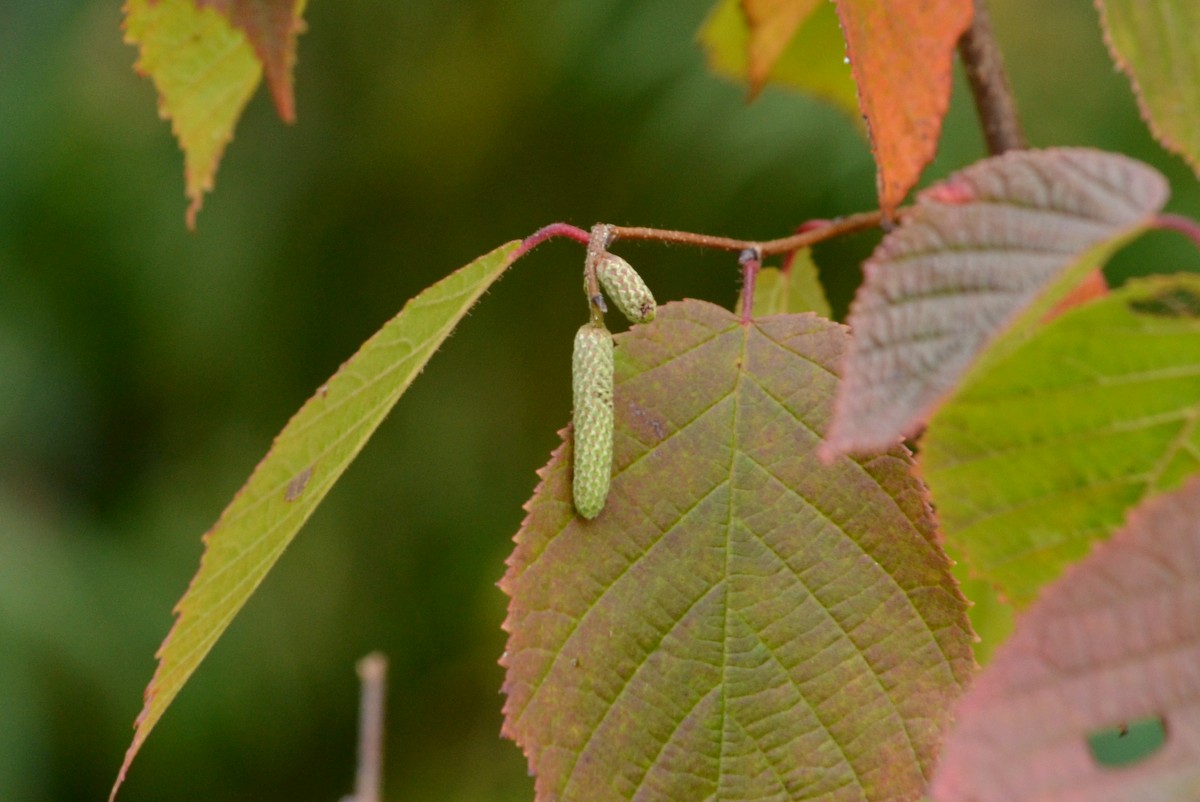
The American Hazelnut bushes I planted in 2017 have now gotten big enough to produce their first little catkins (in preparation for the spring), and I loved seeing these structures dangling among fall-turned leaves in late September:


I think the fall colors of these American Hazelnut leaves are especially beautiful, and they made such a lovely stage for this little yellow caterpillar (I don't know the species) on September 28:


Here's another insect and plant pairing from September 28, this time a katydid with super long antennae on turning sumac leaves:


On October 12, I was happy to come across a Hermit Thrush foraging at the edge of the meadow. What a beautiful bird, whose subtle brown outfit seems so suited for fall:


Other cool encounters from the past few months (without accompanying pictures) include yard bird species #102 -- a couple of Bay-breasted Warblers foraging in our spruce trees on September 12 -- and #103 -- a male Wood Duck flying over our meadow on September 28. In October, something broke apart our bird feeders, and when I asked our neighbors whether bears ever show up in our area, they said they'd seen a bear on their trail camera not too long before. So we're pretty sure a bear came through our yard!

Now that November's winding down (how did we get here already?), the landscape is all brown and dormant, and daylight is getting slim. Our first snow stuck around for a few days and teased winter, but we're not quite into the snowy months yet. That will come soon enough!